



Real Estate Reflections: There's no predicting the 2026 real estate market
.jpg?w=128&h=128)
Paul Reddam
Paul leverages his 25 years of experience in the Austin market to provide individuals with an unparalleled level of personal attention and responsive ...
Paul leverages his 25 years of experience in the Austin market to provide individuals with an unparalleled level of personal attention and responsive ...
I usually start each new year doing a deep dive into the Austin real estate market and offering my predictions about what to expect for the coming year. I did my usual thing this January, but before I could finish my thought things quickly changed, and changed again, and they’ve changed another 10 times since then. The world is too unpredictable for me to make any reliable prediction about the 2026 real estate market. Heavy sigh.
But that doesn’t mean we are completely unanchored… There are several influencing factors I will be watching that are likely to impact how 2026 ultimately shapes up. These indicators will help me (and you) read the market more easily as the year evolves.
A SNAPSHOT OF TODAY'S AUSTIN REAL ESTATE LANDSCAPE
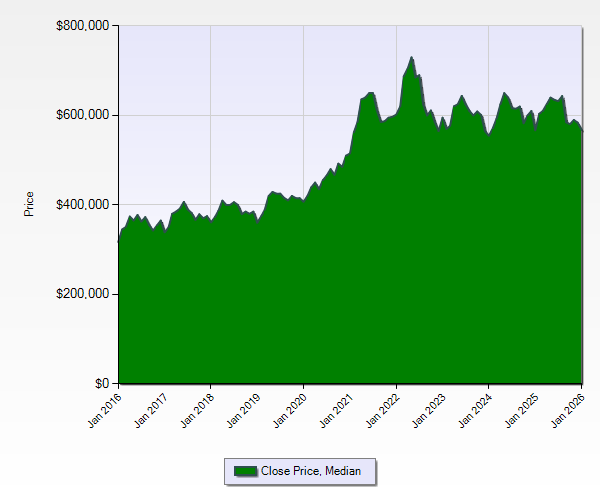
Since the market peaked in April 2022, we’ve been on a mostly downward slide. In fact, the Austin market is down 12.31% since 2022. To put real numbers to it, the median home price dropped from $605,000 to $569,990. That sounds crazy considering that homes are still wildly unaffordable for most folks, but it’s true.
TL:DR? Here’s where things stand in the Austin Housing Market as of February 2026:
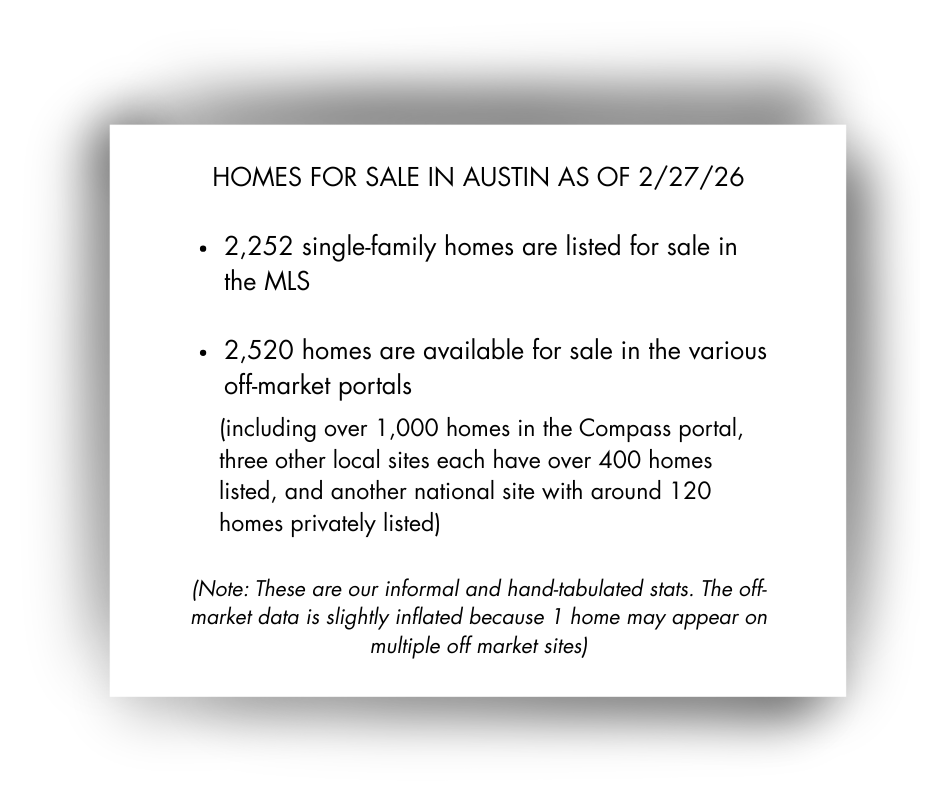
- There’s a large number of homes for sale (i.e. high inventory) in the city of Austin.
- There’s also a large number of homes listed on the private market which means Austin’s home inventory is even higher than is being reported. (See side note for the details)
- Interest rates have been high, which has a depressive effect on a buyer’s purchase power.
- There is a lot of instability in the world making buyers more cautious.
- Buyers are super selective in choosing a home and will only rush in for premium properties that are priced right and don’t need any fix up.
- Some sellers still think it’s the market of 2020 and aren’t pricing their homes to sell.
So that’s where we are.
At its core the Austin real estate market and home prices are driven by what we learned in high school economics: supply and demand. If our supply of homes rises without stronger demand, our inventory of homes builds up and prices often soften. And as you would expect, if our supply of homes goes down due to increased buyer demand, prices will go up. With that foundation in mind, let’s dig into the five factors that could drive supply and demand (and the market) one way or another in 2026.
1) INTEREST RATES WILL IMPACT WHETHER BUYERS MAKE A MOVE IN 2026
Interest rates impact the number of people willing and able to purchase a home, so this is one of those indicators to monitor if you are thinking of making a move in 2026. As of late February 2026 interest rates were hovering just under 6%, which is the lowest they’ve been since September 2022. Of course, as of March 3rd they’ve popped back up to 6.15%, but I think it’s fair to expect high 5s for most of the year.
This is both good and bad news for Austin home buyers. Lower interest rates in the 5s will improve affordability for buyers, increase demand, and result in more home purchases. That said, I’m not betting on a buyer frenzy because of interest rates. We may see some increasing competition for homes from buyers that have been waiting for interest rates to come down, but I don’t think it’s going to be that remarkable.
And remember, Jerome Powell’s term as Chairman of the Federal Reserve is coming to an end, and he will be replaced with Kevin Warsh. I think we may see buyers exercise more caution until they see what kind of Fed Chairman Warsh is going to be.
2) A SEASONAL UPTICK IN BUYER ACTIVITY MAY SET THE TONE FOR THE REST OF THE YEAR
We are entering what is typically the peak season for Austin home sales and prices. The next few months will give us a sense of whether there is enough buyer demand to absorb some of our home inventory.
A history lesson is useful here. Austin’s home market has a predictable seasonality to it. In the spring, home inventory typically increases, buyer activity increases, and home prices go up about 4-7%. Conversely, in the Fall home inventory drops, buyers slow down their search, and home prices drop.
 To take advantage of the Spring momentum, many real estate agents advise their clients to list their homes in March. The result is often a large wave of homes being listed for sale mostly all at once. This will push our already high home supply even higher.
The big question is: will buyers come “March-ing” into the real estate market this Spring?
I’m not sure. Maybe we will see an extremely active March and April and May with buyers absorbing this new home inventory plus some of the old inventory sitting out there. Or maybe it’s the beginning of a sluggish year? Either way, our Spring activity is likely to set the tone for the rest of the year.
3) JOBS & WAGES ARE A GAUGE OF FINANCIAL STABILITY
High employment rates and strong wages provide people the financial stability to make big purchases like buying a house. While it’s not as robust as it has been in the past, according to Opportunity Austin, last year the city’s job growth climbed 0.7%, with final 2025 job growth figures coming out later this month. Even though this is lower than the overall Texas job growth of .9%, it outpaced the U.S. rate of .4% and earned Austin a spot as the 15th best-performing of the Top 50 metros.
Unfortunately, job growth by itself may not be enough. Opportunity Austin reports that the number of unemployed workers increased in each of the last three years ending with an unemployment rate of 3.2% in December 2025, slightly up from 3.1% in December 2024.
Wages also continue to be an issue. The City of Austin increased its living wage to $22.05 in October 2025, but private workers are still subject to the state-wide minimum wage of $7.25. Such low wages make it difficult to buy a house. To afford a median-priced home in Austin in early 2026 you’ll need an annual income of approximately $132,000 says Hilton Supply Management.
We will monitor these indicators as the year goes on, but as it sits today these numbers are unlikely to inspire the average buyer to go out and purchase a home.
4) NET MIGRATION CAN SWAY HOME PRICES & INVENTORY
For years Austin topped the charts as one of the most desirable places to live in the U.S. People wanted to be in Austin, and they moved here in droves during Covid. While net migration has slowed since the Covid-frenzy days of 2020-2022, the stats tell us our beloved city still has a lot to offer. Austin topped the list of growing U.S. cities in a new January 2026 migration report from the Bank of America Institute with a 0.7% year-over-year increase in the city’s net population in 2025.
Although Austin’s population continues to climb, the number of inbound and outbound migrations are almost equal, according to the report. The report notes that "Austin is really emerging as not only a top attraction for talent across the U.S., but also a provider of talent to places ... across the U.S."
While it’s not record-breaking, having workers move both in and out of Austin could have a positive effect on the market. When we have high net migration, home prices tend to go up and inventory goes down. The opposite is also true when net migration is low or we have more people leaving Austin, home prices often stagnate and inventory accumulates. Migration patterns can help us predict which direction the Austin market will go in 2026.
5) OVERALL CONSUMER CONFIDENCE WILL INFLUENCE BUYER & SELLER ACTIVITY
People are more likely to buy homes when they feel stable, and there’s not a lot of stability with anything right now.
Regardless of your political affiliation and regardless of whether you agree, we can’t ignore that a large part of the population is feeling off balance. Call it insecure, uncertain, scared, uneasy, shocked, or whatever. Not everyone feels stable enough in their personal situation or their personal finances to make big moves like a real estate purchase. The recent conflict in the Middle East will only increase that feeling of instability as buyers brace themselves for rising gas prices and more.
On the home front here in Austin, we also have school consolidations on the horizon. While it’s hard to gauge the impact of all the realignment going on within Austin ISD, my guess is that families with children may wait to see how it all shakes out before moving their family.
To put it simply, the world is volatile. Everything is shifting, and whether those shifts impact you personally, they are going to impact real estate. No one likes to make big decisions when life feels uncertain.
SO WERE DOES THAT LEAVE YOU FOR 2026?
I don’t think 2026 will be a complete bust, but I’m not confident it’s going to be robust either. We are starting the year off with high home inventory (6.8 months worth) which makes it a buyer’s market. We expect that inventory number to grow as agents start to list more homes in the coming months. This will be compounded as a portion of the homes listed in the private market portals shift to the MLS to take advantage of Austin’s peak Spring season. I expect our inventory problem is going to get worse before it gets better.
There are a lot of external factors that could impact the buyer demand for our increasing home supply with interest rates topping the list. I’m just not confident interest rates in the 5% range are going to be enough to substantially tip the needle this year. Too many other factors suggest that buyers will exercise caution: modest gains in job growth and wages are being offset by slight increases in unemployment and neutral net migration. In the end, I’m afraid buyer behavior in 2026 will be governed by volatility.
But sometimes life happens and you’ve gotta make a move. If that’s you, here’s our advice for buying and selling a home in Austin this year:
Advice for Austin Home Buyers: This Spring you can expect to see a bump in home inventory that will give you more choices. But remember, mortgage interest rates in the 5s may bring some buyers off the sidelines, especially those that have been putting off making a purchase, so you may see increased competition for quality homes. If you find a good home in a good location this Spring, my advice is to be decisive and move quickly. Otherwise you're gambling that it will still be there if you wait, and the odds may be lower of that this Spring.
Advice for Austin Home Sellers: To be frank, it’s time to adjust your expectations. As one of our Compass colleagues says, success doesn’t come from chasing the market; it comes from understanding it.
In this market, it’s easy to fail. Buyers are still showing restraint and patience as they focus on finding the right home at the right price. Sellers that skip on making key updates or get too aggressive on price can find themselves going weeks or months on the market with no results. Sellers need to adjust quickly to buyer feedback – a low number of showings and no offers means it’s time to adjust your price. Waiting too long while you think it over just means you will be chasing the market down.
WE ARE YOUR GUIDE DURING UNPREDICTABLE TIMES
When the market is unpredictable you need an experienced agent to help you understand the market and position you for success. Expertise matters. Experience matters. Reputation and relationships matter. We are ready to put our 30 years of experience to work to guide you or your friends through this unpredictable Austin market. Just reach out.
February 2026
.png)
Paul Reddam, Associated Broker
Marquette Reddam, Chief of Operations

 You might also like
SNEAK PEEK: Northwest Austin Home Takes All of Your Needs Into Account
This Northwest Austin home has it all -- dedicated home office, soundproof media room, upstairs game room, 2 utility rooms, and a fantastic backyard space with covered patio, outdoor kitchen, dining area, and firepit overlooking a flat yard.
Read MoreUnderstand the full costs of buying a home in Austin
To fully budget for your upcoming home purchase you need to account for the (1) costs you pay before closing, and (2) costs you pay at closing. Let’s break it down so you have a full understanding of the expenses associated with buying a home.
Read MoreFOR SALE: Half-acre retreat in tucked in the pines of Tahitian Village
Tucked among the pine trees on a private half acre lot in Bastrop's Tahitian Village, this 4 bedroom home has a large covered back porch overlooking the swimming pool and surrounding pine woods. This private retreat is a standout.
Read MoreWHAT QUESTIONS DO YOU HAVE?
Technology is great, but sometimes it's nice to talk to a real person. Reach out for a no obligation, no BS consult.
Call or text us:
512-789-0869
Email us:
[email protected]
"We've worked with many different Realtors before, and without hesitation, none of them compared to Paul. He was clearly most concerned with helping us meet our needs first and foremost. We never felt rushed or pressured."
-- Audrey O.
Thanks for your interest!
Someone will reach out shortly. In the meantime, learn more about our team.